Mushrooms are fascinating organisms with unique structures. Understanding the different parts of a mushroom can greatly assist in identifying wild mushrooms. Here’s a guide that highlights and references to the various parts of a mushroom that are used to identify them: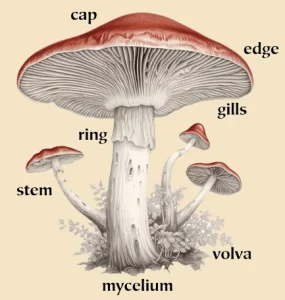
Cap (Pileus): The cap is the uppermost part of the mushroom. It can have various shapes, colours, and textures, ranging from flat to convex or even funnel-shaped. Take note of its size, colour, surface texture, and any distinctive markings.
Gills (Lamellae): Gills are the thin, vertical structures found on the underside of the cap. They radiate from the stem and play a vital role in spore production. Observe the colour, shape, spacing, and attachment of the gills. Sometimes mushrooms do not have gills at all, instead having pores.
Stem (Stipe): The stem supports the cap and connects it to the ground. It can be cylindrical, tapered, or bulbous. Note the length, thickness, colour, texture, and whether it has any rings or scales.
Ring (Annulus): The ring is a circular or collar-like structure that encircles the stem. It is a remnant of the veil that protects the developing gills. Pay attention to its position on the stem and its size, colour, and texture.
Volva: The volva is a cup-like or sack-like structure at the base of some mushrooms. It is a remnant of the universal veil that originally enclosed the entire mushroom. Note its presence, shape, colour, and texture.
Credit: wildfoodie.co.uk